Custom software that solves your problem. With AI where it helps.
Custom software, SaaS products, automation and voice agents. From an office of three people to an organisation with thousands. Sometimes with AI, sometimes without, that depends on your problem, not on fashion. I think along with you, run the whole track, and keep it demonstrably compliant with GDPR, the EU AI Act and the Data Act.
You get me on the line, no phone menu. Bad timing? Book a thirty-minute call below instead.

An example of what a voice agent can do: answer, ask the right questions, book an appointment and pass the rest on to you.
Three reasons AI keeps getting postponed
One of these comes up in almost every first conversation. All three are fair.
“I don't know where to start”
You see ten tools and a hundred promises, but nobody tells you which process in your company should go first.
We start with an audit of your processes. At the end you know the three candidates and what each one returns.
“I'll pay for something that stalls”
A demo always works. The question is whether it survives a real customer saying something unexpected.
Fixed price per phase. Phase one is small and has a measurable target. If it misses, it stops there.
“I don't have time for this”
Every project asks attention from your team. That attention isn't there, which is exactly why you want to automate.
Two hours from your side in week one, then half an hour a week. I do the rest.
What I build for you
Not a catalogue. This is what I work in daily, with what you concretely get. A voice agent is one example, just as often I build software with no AI in it at all, or AI without speech.
Voice agents and telephony
An agent that answers the phone after hours, at peak moments and when everyone is already on a call. It recognises why someone is calling, books an appointment in your calendar, transfers when unsure and emails you the rest.
Priced per case. In the discovery call we establish how many call types it must handle and which systems it connects to. You then get a fixed quote.
Read more about this service →Process automation
The work nobody enjoys: retyping invoices, moving data from system A to system B, producing the same report every Monday. I map the steps and build the chain that runs without you.
Priced per case. We first measure what the process costs you today and how complex the integrations are. You then get a fixed quote per phase.
Read more about this service →Custom software, SaaS & AI assistants
For when off-the-shelf doesn't fit: a portal, an internal tool, or an assistant that answers from your own documents and data. Built around your way of working, not a vendor's.
Priced per case, always in phases with a fixed price per phase. After the discovery call you know exactly what phase one costs and what comes out of it. You're never committed beyond one phase.
Read more about this service →AI audit & AI training
The cheapest way to start. I come to you, and afterwards you get a report with the processes that return the most, what each costs, what it saves and what goes wrong if you approach it badly. I also run AI training for teams: what the technology can and cannot do, how to use it safely, and where the gains sit in your own work.
Priced per case: an office with three people needs a different audit than an organisation with fifteen hundred. We size it in the discovery call, then you get a fixed price. If you then build with me, that amount comes off the first invoice.
Read more about this service →Work running at a client today
One case, written up as it actually went. More will follow as clients give permission.
Equote connects advertisers with website owners. To do that they approach websites in twenty countries with one question: may we place an article here, and what does it cost? The answers arrive as individual emails, each phrased differently. Two people pulled the price, the domain, whether the link is follow or nofollow and a range of other details out of them by hand, and typed all of it into a list.
What I built
The outbound campaigns run through Instantly. I pull the incoming replies in through the API and route them, alongside Instantly, into an automation flow in n8n. There every message first passes a set of conditions: is there a price, is there a domain, is it a reply to an existing thread, and several more criteria. Whatever fails is skipped, so no noise enters the list. Whatever passes is read out by AI: price, domain, follow or nofollow and the remaining details, in one consistent format. That goes straight into a Google Sheet on the client's own Drive, where the team picks it up.
What it returns
The copying two people did every day now happens automatically. They only look at the cases that genuinely stand out. The list is also more consistent than before, because every message passes the same conditions instead of somebody's judgement on a busy afternoon.
This is what a voice agent sounds like
A customer calls and has an appointment booked within ten seconds. No phone menu, no queue.
This is a short demonstration. If you want to try it with your own opening question, I'll set that up before our intro call.
+31 6 1741 1988Does your AI fall under the EU AI Act?
Ten questions, about three minutes. You see straight away which risk category your application falls into, what the AI Act and the GDPR ask of you, and where to start. No account, no cost.
Thinking along, arranging it, staying inside the law
Three things that don't fit in a service list, but that decide how working with me feels.
I think along with you
You're not hiring a pair of hands that builds whatever the brief says. If I think your question isn't your real problem, I'll say so. Often there's a simpler or cheaper route, and sometimes the answer is that you shouldn't build this yet. Sparring over that choice is part of the work.
You don't have to figure it out
I run the whole track: choice of technology, the build, integrations with your existing systems, testing with real cases, explaining it to your team and maintenance afterwards. One point of contact, and one person responsible when something breaks. No vendors pointing at each other.
Compliant, and provably so
Everything I build has to survive current legislation: GDPR, the EU AI Act and the Data Act. That means agreeing up front which data the system may see, processing inside the EU, retention periods, a data processing agreement and a log of what the system did. So you can explain it when somebody asks.
Cybersecurity and penetration testing
The odd one out in my offering, and deliberately so. A lot of software now sits online protecting customers and their data, and that software needs someone looking at it critically too. I test what I and others build, before somebody else does.
Book a call →What is a pen test?
A pen test is an attack on your own software, carried out with your written permission. I try to get in the way someone with bad intentions would: logging in without the right password, reaching another customer's data, changing a price in an order. Whatever works, I write down with evidence attached, plus what needs to be done about it and how you later check that it is really closed.
From the outside in
I get only your web address and nothing else. Exactly what any outsider has. I work out for myself which pages, integrations and open ports exist, and test what can be abused.
Good for a first picture, or a yearly check on a public site.
With an ordinary account
You give me a test account, the kind your customers have. Then I also test everything behind the login: can a user reach someone else's file, stretch their permissions, or skip steps in a process.
This returns the most per hour. A real attacker simply signs up for an account too.
With the blueprints included
You hand over the source code or the container. Then I also see what stays invisible from outside: passwords left behind in the code, outdated components with known holes, and mistakes in the way something was built.
This is also where the mapping to standards and legislation belongs.
What I look at
What you get
What I don't promise
Nobody finds everything, and anyone who promises that is selling you something. So the report also states what was not tested and where I stopped. Automated testing does not replace an experienced specialist spending days on one application; it delivers the systematic half, provably and repeatably. Weeks of quiet intrusion including tricking your staff is not something I do. And I never test without the owner's written permission.
Where I've seen the most
Four kinds of organisation where the phone line and the paper flow are the bottleneck, from small offices to large institutions.
Healthcare providers and clinics
The practice line is jammed between eight and ten. Whoever can't get through calls the clinic next door.
Medical content stays with the practitioner. The agent doesn't triage, it schedules and informs.
Insurance
Every claim is the same twenty questions, followed by manual entry.
Coverage decisions stay human work. AI does the groundwork.
Financial services
Deadline pressure on every filing, and reports assembled by hand.
Everything we build leaves a trail: who, when, and from which source.
Property appraisers
Every file means recording, writing up, and describing the same components again.
The valuation stays with the appraiser. AI takes over the writing and the looking up.
What else I have built
I built these myself, not on commission. They work, and I use them to show what is possible; if something here resembles your problem, we have a head start.
Penetration testing platform
Scans websites, integrations and source code and produces a report with evidence and retest criteria. This is the engine behind my security work.
Incident reporter for healthcare
Care staff report an incident in a few taps and get immediate feedback and guidance.
HR assistant on the staff handbook
Employees ask a question and get an answer from their own handbook, with the source attached.
Land valuation application
Property data and sources brought together, with a draft the appraiser only has to review.
Risk inventory and evaluation
Work through a risk assessment, record it and keep the resulting actions current.
Logistics replanner
Replans schedules the moment a machine or a staff member drops out.
CRM and time tracking
Contacts, hours and mileage. Built for my own use and used daily.
Business intelligence without a licence
Drop in a CSV or an export, get charts and insight straight out.
Anti-fraud application
Recognises patterns that point to fraud and warns before the money is gone.
Product configurator
Customers assemble their own product; the result is immediately a correct order.
More on the shelf: a case flow for law firms, a fire safety drawing application, a dictation tool, a date planner, an employee satisfaction survey and a portal that pushes car dealer photos to their website. Ask me about it in the call.
What this work looks like from the inside
Articles I write because the same questions keep coming back. Enough detail to try it yourself, even if you don't hire me.
Why most AI pilots never go live
Not because the model is too weak. Four causes I find in almost every stalled project, and how to cover them in week one.
Read the article →What an AI voice agent really costs, down to the minute
A cost model with the four line items nobody mentions in the demo, and the point where the agent pays for itself.
Read the article →Your documents aren't ready for AI yet. Here's how to fix that.
Why a chatbot on your manuals often answers wrongly, and the four interventions that fix it without training a model.
Read the article →Which process do you automate first? Five questions as a scorecard.
The method I use in every audit to get from twenty ideas to one first project. With the arithmetic included.
Read the article →The person you'll be working with

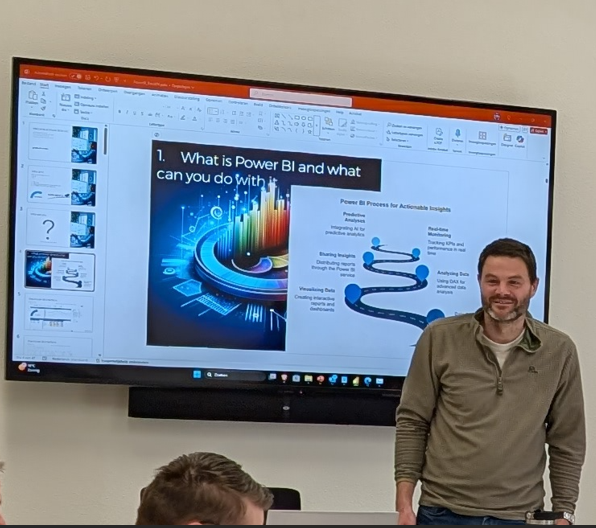
Training at a client. Besides building, I teach teams to carry on with AI themselves.
Ronald Postelmans
Founder of Datawonder · Zevenaar, NL
I've worked with data for ten years and founded Datawonder in 2021 to put that craft directly to work for the people who use the result, from a small office to a large organisation. Over those years I did a lot of data work: opening up sources, setting up reporting and teaching teams to work with their own numbers. That background is what I now build on.
What I enjoy most is building software that solves a real problem for a client. Not technology for its own sake, but something that simply works on Monday and makes someone say: that just saved me half a day. When I started working with AI a few years ago, it took me a couple of weeks to know I wanted to go all in. Ten years of data plus these new possibilities is exactly where Datawonder stands today: software with AI that works for the client.
That background shapes how I look at AI. A language model is not the project. The project is the process around it: where the data comes from, who checks the output, what happens with an exception, and how you'll still know in three months that it works. That part gets skipped in most AI stories, and it's exactly where projects fall apart.
In meetings I usually sit between two kinds of people: the owner who wants to know what it returns, and the technical party who wants to know how it works. Translating between them is my job, preferably without jargon. If something is a bad idea for your business, I'd rather say so in the first conversation than three invoices later.
Direct contact
You work with me, not an account manager. No ticket system.
Fixed price per phase
You know what a phase costs and what comes out of it. No open-ended hours.
Measurable or not at all
Every phase has one number as its target. If we miss it, we adjust or we stop.
Small and large
From sole traders to organisations with thousands of staff. At a large company I work alongside an internal IT department or an existing vendor just as easily.
Pick a slot in my calendar yourself
Thirty minutes, video or phone. You tell me where the hours in your business go, I tell you whether AI changes that, and if it doesn't, you'll hear that too.
You pick a slot in my Google Calendar and get an immediate confirmation with the link for the call.
What people ask first
What does working with Datawonder cost?
I can only tell you once I know what you want. An audit at an office with three people is a completely different job from one at an organisation with fifteen hundred, and the same goes for a voice agent or an automation. That's why every engagement starts with a free discovery call. I find out what you actually need, and from that I write a quote with a fixed price per phase. So you know what you're spending before you spend it.
How long does a typical project take?
A first automation is usually live in two to three weeks, a voice agent in three to four, custom software depends on scope. I cut everything into phases that deliver something working within six weeks.
I'm not technical. Is that a problem?
No. I need your knowledge of your business, not of technology. You won't hear jargon from me, and with every decision I explain what it means in time and money.
Do you only work with smaller companies?
No. Most of my clients are small and mid-sized, but I work with larger organisations just as well, often alongside an internal IT department or an existing vendor. What doesn't change is the approach: one point of contact, phases with a fixed outcome, and thinking about the question behind the question. What does change is the size of the track and the number of people who need to be involved.
What if the result disappoints?
Every phase has one measurable target agreed up front. If we miss it, I adjust until it works or we stop after that phase. You're never locked into a year-long programme.
What about the privacy of my data?
We agree up front which data the system may see and how long it's kept. Processing happens inside the EU under a data processing agreement. Where possible personal data stays out, and otherwise only what's strictly needed goes in.
Can I start with something small?
That's my preference. Start with the audit or with one process. If it works, we take the next one. If it doesn't, you've spent a limited amount and three weeks instead of an annual budget.
Do you work in English or German?
Yes. Conversations, documentation and the agents themselves can run in Dutch, English and German. For German clients I work with German-language voices and scripts.
Ready to see what's being left on the table?
Book a free thirty-minute call. You'll get an honest answer, even when that answer is “don't do this yet”.
Book your free intro call → Free · 30 minutes · no obligations